
Designing Ratios
How Ginsenoside Balance Defines the Function and Identity of Ginseng

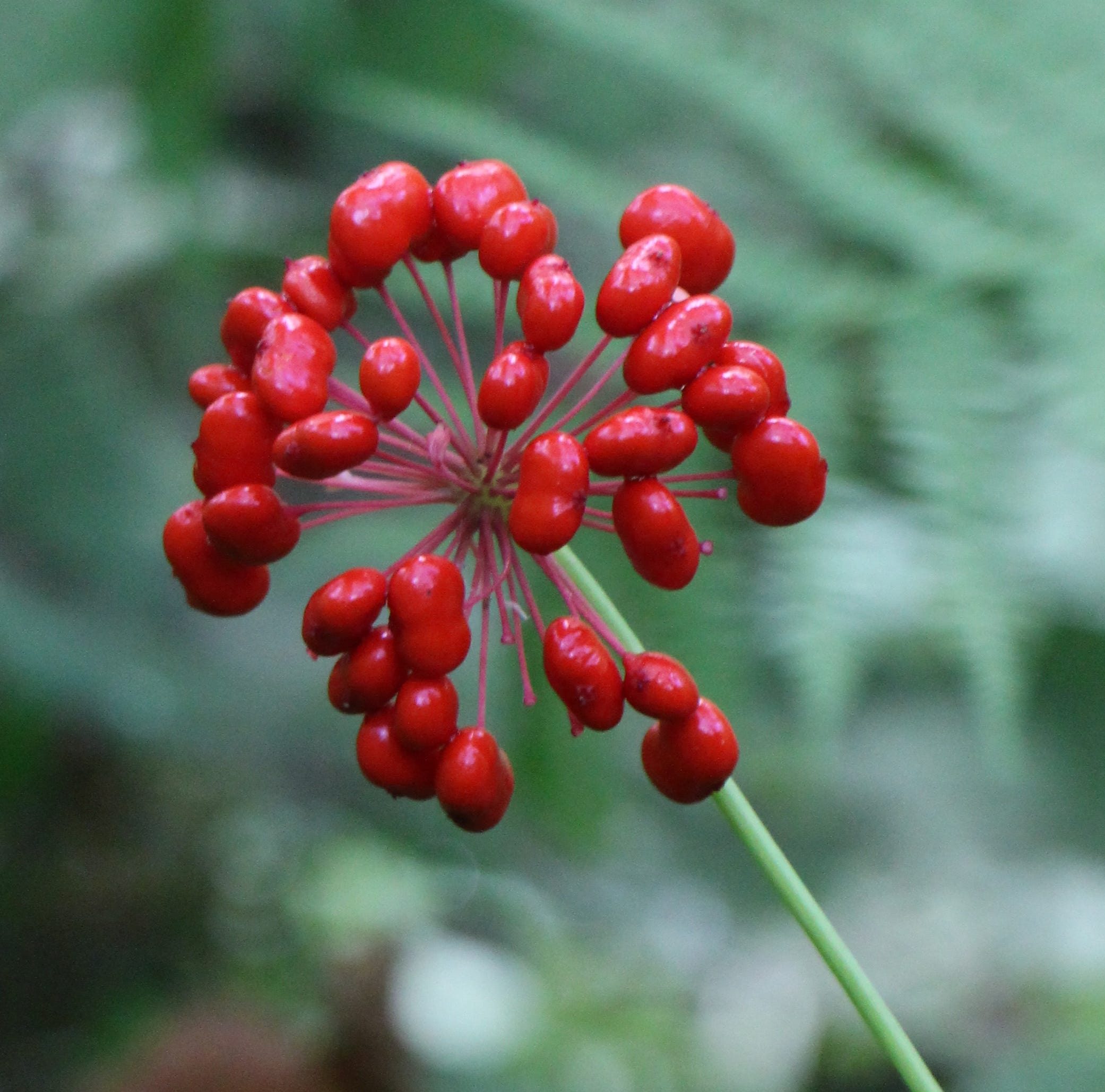
This image was cropped from the original, https://commons.wikimedia.org/wiki/File:Ginseng_flower_in_Changbai_Mountain.jpg
Ginsengʼs therapeutic reputation has always rested on its ginsenosides. However, what defines the plants pharmacological character is the ratio structure within its metabolite pool, which increasingly is becoming the foundation of both quality control and function-driven herbal product design.
Ratio as a Marker of Identity
The chemical distinction between Panax ginseng (Asian ginseng) and Panax quinquefolium (American ginseng) lies in predictable ginsenoside ratios. Wu et al. (2019) differential ion mobility spectrometry–mass spectrometry (IMS-MS) that separates gas phase ions by mass based on their interaction with a collision gas. They established diagnostic benchmarks: American ginseng typically shows Rg1/Re < 0.15, Rb1/Rg1 > 2.15, and Rb2/Rc < 0.26, alongside the F11 marker (American) and absence of Rf (Asian). These ratios provide more robust authentication than total ginsenoside content, which varies with age and processing.
Population-level studies confirm this species-specific ratio stability. Schlag and McIntosh (2006) found strong inverse correlation between Rg1 and Re (r = –0.70), with American ginseng forming two chemotypes: High-Rg1/Low-Re and Low-Rg1/High-Re. These patterns are genetically anchored and persist across cultivation sites. Thus, ratio profiling functions as a chemical fingerprint that survives extraction and geography.
Ratio as a Measure of Maturity and Ecological Fitness
Harvest age directly shapes ginsenoside ratios. In American ginseng, total ginsenosides increase from about 3% to 8% between one and four years of growth, but composition stabilizes only after the fourth year (Court et al., 1996). The U.S. Fish and Wildlife Service requires that exported wild-harvested roots be at least five years old (USFWS, 2009). Asian ginseng shows a different trajectory.
In wild-cultivated roots aged five to eighteen years, He et al. (2016) found that major ginsenosides (Rg1, Re, Rb1, Rc, Rg2, Rd) increase until roughly sixteen years before declining.
Leaf tissue in wild American ginseng contains more total ginsenosides than roots, dominated by Rb2 and Re, while roots accumulate Rb1 as the main component (Searels et al., 2013). This internal partitioning maintains systemic chemical defense and highlights that tissue type, not just age, defines usable ratio signatures.
Ratio Engineering Through Processing
Processing methods can intentionally shift ratio balance, producing functional variants. Heat treatment (steaming) converts major protopanaxadiol glycosides (Rb1, Rc, Rd) into rare, dehydrated forms such as Rg3, Rk1, Rk2, and Rg5 (Li et al.,2022). These “red ginsengˮ transformations alter the chemical and biological profile, improving lipid solubility, absorption, and physiological potency for specific treatment conditions.
Thermal conversion essentially raises the ratio of rare to major ginsenosides, a relationship expressed as the following ratio: (Rg3[20S+20R] + Rk1 + Rg5 + Rh4)/(Rb1 + Rc + Rd). Experimental data support this as a developmental quality-control marker for vascular or erectile dysfunction endpoints, where these rare saponins demonstrate enhanced smooth-muscle relaxation through cGMP–Ca²⁺ modulation (Ying et al., 2018). The ratio thus becomes a mechanistic bridge between processing technology and pharmacological intent.
Biotransformation of Ratios
Gut microbiota convert large, polar ginsenosides (Rb1, Rc, Rd) into smaller, more bioavailable metabolites (Compound K, Rh2, Rg3). Fan et al. (2024) propose tracking the ratio (Compound K + Rh2 + Rg3)/(Rb1 + Rc + Rd) in fermented or enzyme-pretreated products to predict bioactivity. The concept reframes gut metabolism not as variability but as a design parameter.
Ratios as Pharmacological Predictors
Different ratio states correspond to different therapeutic targets:
· Vascular function: High (Rg3[20S+20R] + Rk1 + Rg5 + Rh4)/(Rb1 + Rc + Rd) ratios favor smooth-muscle relaxation (Ying et al., 2018).
· Metabolic and oncology applications: Elevated (Compound K + Rh2 + Rg3)/(Rb1 + Rc + Rd) ratios indicate enhanced bioavailability and cytoprotective potential (Fan et al., 2024).
· Neurophysiological outcomes: Extracts richer in protopanaxadiol (PPD) over protopanaxatriol (PPT) ginsenosides produce stronger neuronal inhibition in brainstem models (Yuan et al., 2001).
These examples show that ratios encode not only authenticity but mechanistic directionality, predicting which formulations will favor vascular, metabolic, or neural endpoints.
Ratio-Driven Standardization as Design Philosophy
From a design standpoint, ginsenoside ratios translate molecular complexity into controllable manufacturing variables. Instead of more ginsenoside equals better the model defines optimal proportional balance. This enables the processing step to be part of the tuning apparatus to shift ratios toward target pharmacological outcomes. This ratio-informed specifications provide a traceable path from seed genetics to finished dosage form, linking CITES-compliant harvest age, validated analytical profiles, and intended function.
References
1. Court, W. A., Hendel, J. G., & Elmi, J. (1996). Influence of root age on the concentration of ginsenosides of American ginseng (Panax quinquefolium). Canadian Journal of Plant Science, 76(3), 853–855. https://doi.org/10.4141/cjps96-144
2. Fan, T., Wang, L., Zhao, Y., & Chen, X. (2024). Rare ginsenosides: A unique perspective of ginseng research. Journal of Ginseng Research, 48(1), 1–15. https://doi.org/10.1016/j.jgr.2023.09.004
3. He, J., Yue, R. Q., Wei, D. D., et al. (2016). Variation of ginsenosides in ginseng of different ages. Natural Product Communications, 11(9), 1385–1388. https://doi.org/10.1177/1934578X1601100943
4. Li, W., Gu, C., Zhang, H., et al. (2022). Classification of three types of ginseng samples based on ginsenoside profiles. Phytochemistry, 200, 113244. https://doi.org/10.1016/j.phytochem.2022.113244
5. Schlag, E. M., & McIntosh, M. S. (2006). Ginsenoside content and variation among and within American ginseng (Panax quinquefolius) populations. Phytochemistry, 67(14), 1510–1519. https://doi.org/10.1016/j.phytochem.2006.05.001
6. Searels, T., Deng, Y., & Clevenger, D. J. (2013). Comparing ginsenoside production in leaves and roots of wild American ginseng (Panax quinquefolius). Journal of Medicinal Plants Research, 7(28), 2076–2082. https://doi.org/10.5897/JMPR12.1205
7. US Fish and Wildlife Service (USFWS). (2009). American ginseng (Panax quinquefolius) management and export program.S. Department of the Interior.
8. Wu, L., Song, F., & Zhou, X. (2019). Rapid differentiation of Asian and American ginseng by differential ion mobility spectrometry–mass spectrometry. Analytical Chemistry, 91(14), 9107–9114. https://doi.org/10.1021/acs.analchem.9b01743
9. Ying, C., Wang, J., & Zhang, X. (2018). Structural–activity relationship of ginsenosides from steamed ginseng in the treatment of erectile dysfunction. Journal of Ethnopharmacology, 225, 58–66. https://doi.org/10.1016/j.jep.2018.06.005
10. Yuan, C. S., Wang, C. Z., & Wicks, S. M. (2001). Effects of Panax quinquefolius on brainstem neuronal activities in vitro. American Journal of Chinese Medicine, 29(3–4), 493–500. https://doi.org/10.1142/S0192415X01000573